EEG – Electroencephalography
What is an EEG?
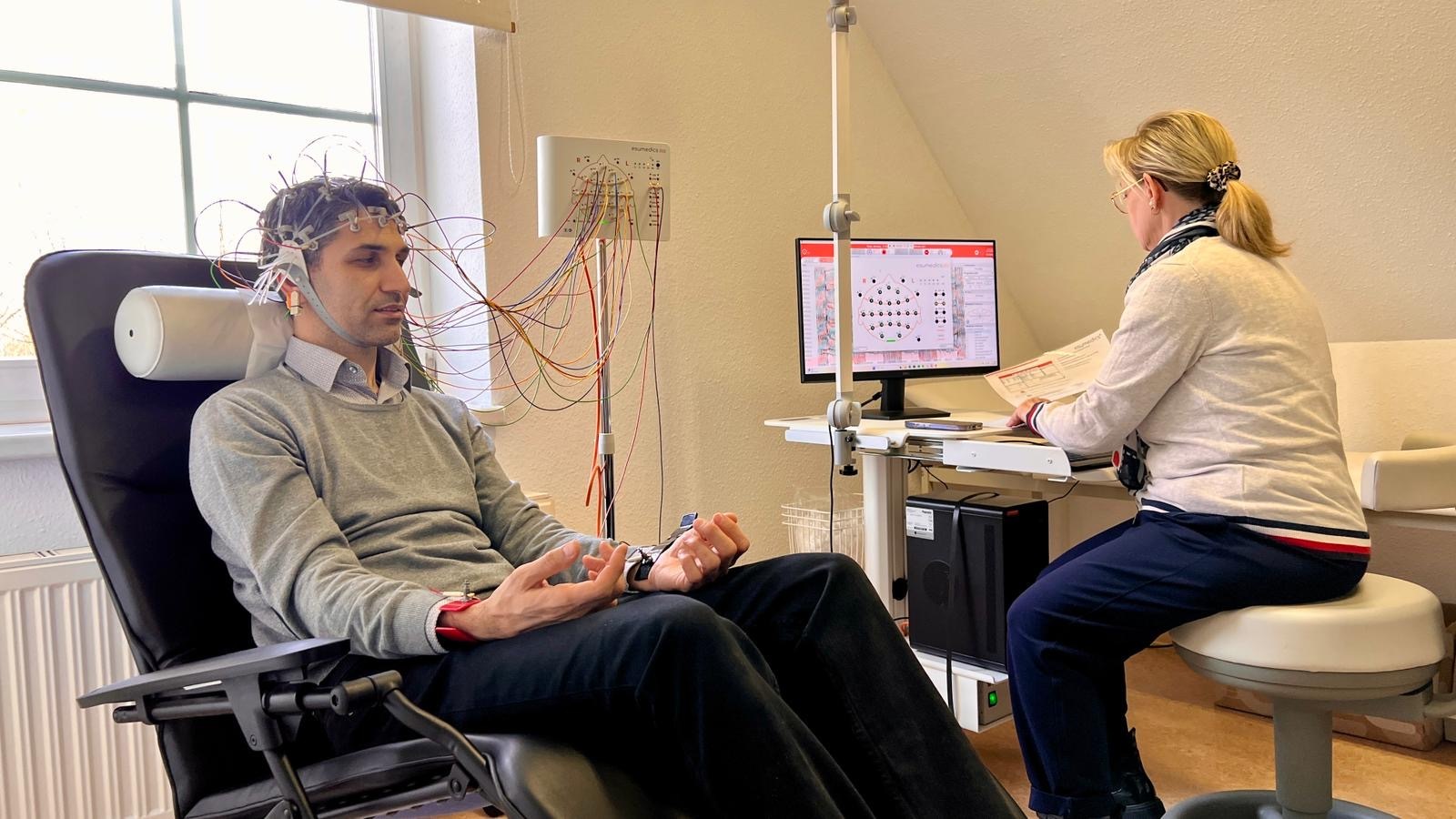
Electroencephalography (EEG) is a painless, non-invasive procedure for measuring the electrical activity of the brain. Using small electrodes attached to the scalp, the brain waves are recorded and displayed as wave patterns on a screen.
The brain consists of billions of nerve cells (neurons) that continuously exchange electrical signals. This electrical activity can be recorded at the surface of the head and provides information about the functional state of the brain.
When is an EEG performed?
An EEG is used when a disorder of brain function is suspected. Typical reasons for an EEG examination are:
- Investigation of epileptic seizures or suspected epilepsy
- Disorders of consciousness or unexplained unconsciousness
- Unexplained transient neurological deficits, e.g. temporary speech, visual or sensory disturbances
- Concentration and memory disorders, particularly if dementia is suspected
- Monitoring of known epilepsy under medication therapy
- After a stroke or traumatic brain injury to assess brain function
How does an EEG work?
Preparation
Before the examination, small electrodes are attached to the scalp with a conductive paste. In our practice, we use a digital EEG system from a German manufacturer (commissioned in 2026) that allows precise recording. The attachment of the electrodes is painless.
Course of the examination
The actual measurement usually takes 20 to 30 minutes. During the recording, you lie relaxed on a couch with your eyes closed. Over the course of the examination, various provocation methods are used:
- Opening and closing the eyes – to assess the baseline activity
- Hyperventilation – deeper breathing over several minutes to elicit certain brain activity patterns
- Photic stimulation – rhythmic light stimuli with a flash lamp to test the brain’s response to visual stimuli
These provocations are important because certain abnormalities (e.g. epilepsy-typical patterns) only become visible under these conditions.
Evaluation
The recorded brain waves are displayed as curves and evaluated by the specialist. The frequency, amplitude and shape of the waves are assessed, and abnormal patterns are looked for.
Which EEG procedures do we offer?
- Resting EEG – Standard examination in an awake, relaxed state
- Provocation EEG – with hyperventilation and photic stimulation to increase the diagnostic significance
Which diagnoses are possible with an EEG?
Epilepsy and epileptic seizures
The EEG is the most important diagnostic procedure for epilepsy. It can detect epilepsy-typical potentials (spikes, sharp waves, spike-wave complexes) and helps to distinguish between different forms of epilepsy as well as in treatment planning and monitoring.
Encephalopathies
Diffuse brain function disorders, e.g. due to metabolic diseases, medication effects or inflammation, appear in the EEG as a slowing of the baseline activity.
Dementia-related disorders
If Alzheimer’s dementia or other dementia-related disorders are suspected, the EEG can provide indications of the severity of the brain function disorder.
Disorders of consciousness
The EEG helps to assess disorders of consciousness and can differentiate between various causes (epileptic, metabolic, structural).
Is the examination painful?
No. The EEG is a completely painless and risk-free examination. No electrical currents are passed into the body – the electrodes merely measure the natural electrical activity of the brain. The examination can be repeated as often as needed.
Preparing for the examination
- Wash your hair on the day of the examination, but do not use hairspray, gel or hair oil
- Take your medication as usual, unless otherwise agreed
- Inform us about all medications you are taking
- For epilepsy patients: Please bring your seizure diary with you
You can book an appointment for an EEG examination here
Last updated: 2026-08-28